


The chorus of Taylor Swift’s “The Fate of Ophelia” exemplifies the precision and accessibility of Max Martin-style “melodic math,” where structure, logic, and emotion converge to maximize listener connection. Much like the Hit Songs Deconstructed K.I.S.S. ME principle (Keep It Simple, Singable, and Memorable), the chorus melody strikes an ideal balance between repetition, variation, and simplicity.
Primarily built on stepwise motion, short phrases, and rhythmically engaging eighth- and quarter-note patterns, the chorus ensures immediate singability. Yet Swift and her collaborators elevate this simplicity through intricate hook layering and incorporating A.M.P.s (Alternating Melodic Patterns), E.O.L.A.s (End-of-Line Accentuators), and background vocal call-and-response techniques.
The result is a chorus that embodies the best of modern pop design, mathematically crafted for memorability, yet emotionally resonant and unmistakably Taylor Swift.
Melodic Qualities
The melodies in “The Fate Of Ophelia’s” chorus largely adhere to the Hit Songs Deconstructed K.I.S.S. ME principle (Keep It Simple, Singable, and Memorable), ensuring listeners can easily connect with and recall the song’s primary “hook center.”
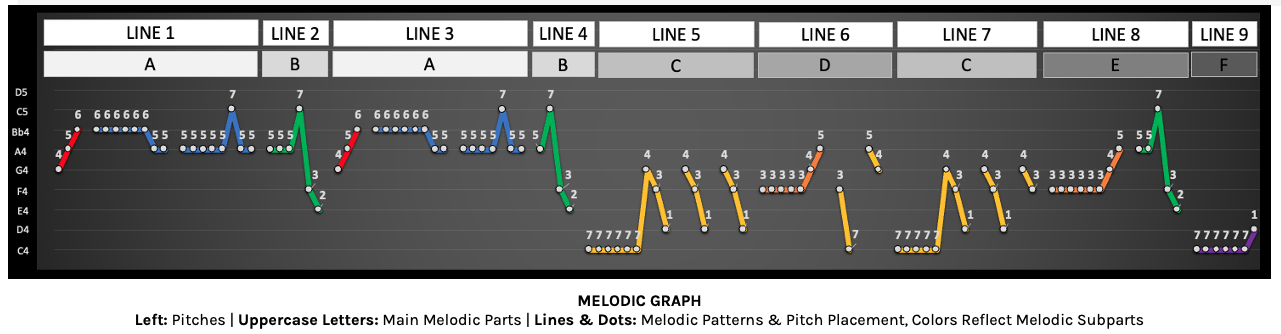
Its K.I.S.S. ME qualities include:
- Motion: Primarily stepwise and stagnant motion and small leaps.
- Patterns: Logically unfolding melodic patterns within and across lines.
- Rhythms: Mainly simple, easy-to-lock into eighth-note and quarter note driven rhythms.
- Line & Phrase Length: While full lines range from short (4 syllables) to long (19 syllables), most are broken into shorter, easier to digest segments raging from 2 to 8 syllables through melodic contrast, rhythmic contrast, and rests.
“The Fate Of Ophelia” also deviates from the K.I.S.S. ME principle in two key areas:
- Intervallic Leaps: The song title hook melody in lines 2, 4, and 8 (“now I see it all,” “O-phe-li-a,” “you’ve been dream-in’ of”) features a more complex ascending leap of a third followed by a descending leap of a fifth. While this makes the hook a bit more challenging to sing along to, it also serves as its defining melodic trait and enables it to further stand out and connect.
- High Range: The first stanza (lines 1-4) resides in a relatively high range. However, it provides engaging contrast against the lower-range pre-chorus, enabling the chorus to further stand out and connect at first listen.
Stanza 1 Melodic Structure (Lines 1-4)
The first stanza of the chorus features an ABAB main melodic structure across its four lines, providing an effective balance of repetition and contrast. This structure is the most common chorus structure found in Max Martin hits.
However, peering deeper into the stanza’s melodic substructure is where the true melodic math craftmanship comes to light.
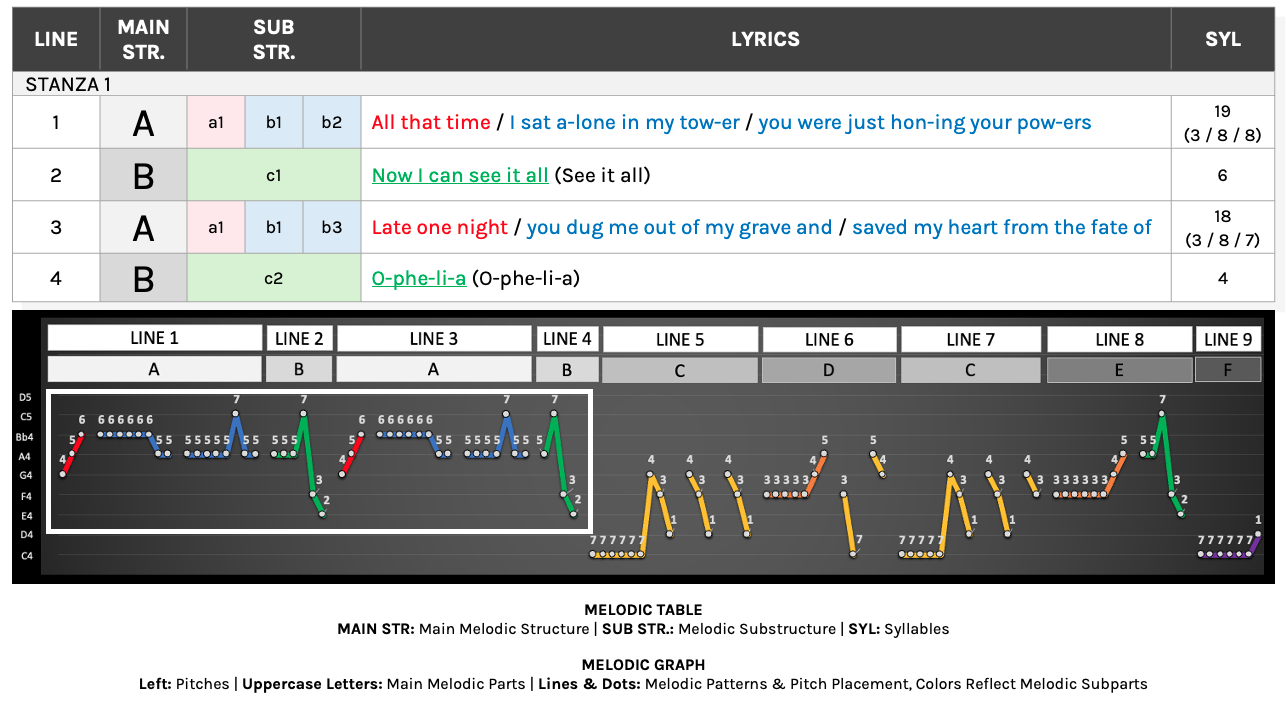
Line 1
Line 1, which is comprised of 19 syllables, is broken into three shorter, easier-to-digest melodic subparts:
- Subpart a1 (3 syllables): The chorus begins with a short, ascending three-note melody across scale degrees 4-5-6 with a steady quarter note rhythm. This simple pickup serves to engage the lister coming out of the pre-chorus and allow the b-melody developments that follow to further stand out in comparison.
- Subpart b1 (8 syllables): Subpart b1 shifts to a more vibrant eighth note driven rhythm mainly centered on scale degree 6 with a two-note conclusion on scale degree 5.
- Subpart b2 (8 syllables): Subpart b2 maintains the core qualities of subpart b1 with its mostly monotone, eighth-note driven delivery. However, it differs by residing a step lower on scale degree 5 and features a leap up to scale degree 7 in the third to last syllable. While subtle, this leap serves a few key purposes: it creates an additional commonality with subpart b1 (b1: 6-5-5 / b2: 7-5-5), it provides a brief engaging embellishment against the stagnant notes that precede and follow, and it subtly foreshadows the defining leap in the song title hook melody that follows in line 2.
Line 2
Following the fast moving, direct qualities of the subpart b melodies in line 1, line 2 provides an engaging variation in the subpart c1 melody. Consisting of 6 syllables, it initially begins where subpart b2 left off with three fast-paced notes centered on scale degree 5 on the lyrics “now I can.” However, it concludes with a notable deviation with a leap of a third to scale degree 7 directly followed by a drop across scale degrees 3-2 in the lyrics “see it all” in conjunction with more sustained deliveries. Known as the Hit Songs Deconstructed E.O.L.A. (End-Of-Line Accentuator) technique, this variation achieves a few key objectives:
- Serves as an engaging conclusion to the line 1-2 pairing.
- Spotlights the lyrical development.
- Melodically foreshadows the “O-phe-li-a” song title hook that appears in line 4 and accentuates their near-rhyme connection.
Lines 3 & 4
Lines 3 and 4 feature nearly identical melodic qualities as lines 1 and 2, further reinforcing the chorus in the listener’s mind while showcasing the “O-phe-li-a” song title hook. In addition, note that both iterations of the song title hook melody are directly repeated as background vocals – further heightening catchiness, flow, and memorability.
Stanza 2 Melodic Structure (Lines 5-9)
The chorus’s second stanza heightens engagement by shifting to a CDCEF main melodic structure across its five lines. The initial C-D-C progression provides an effective balance of repetition and contrast, while the more pronounced variation in the concluding E-F melodies further heightens interest while cleverly tying back to the first stanza.
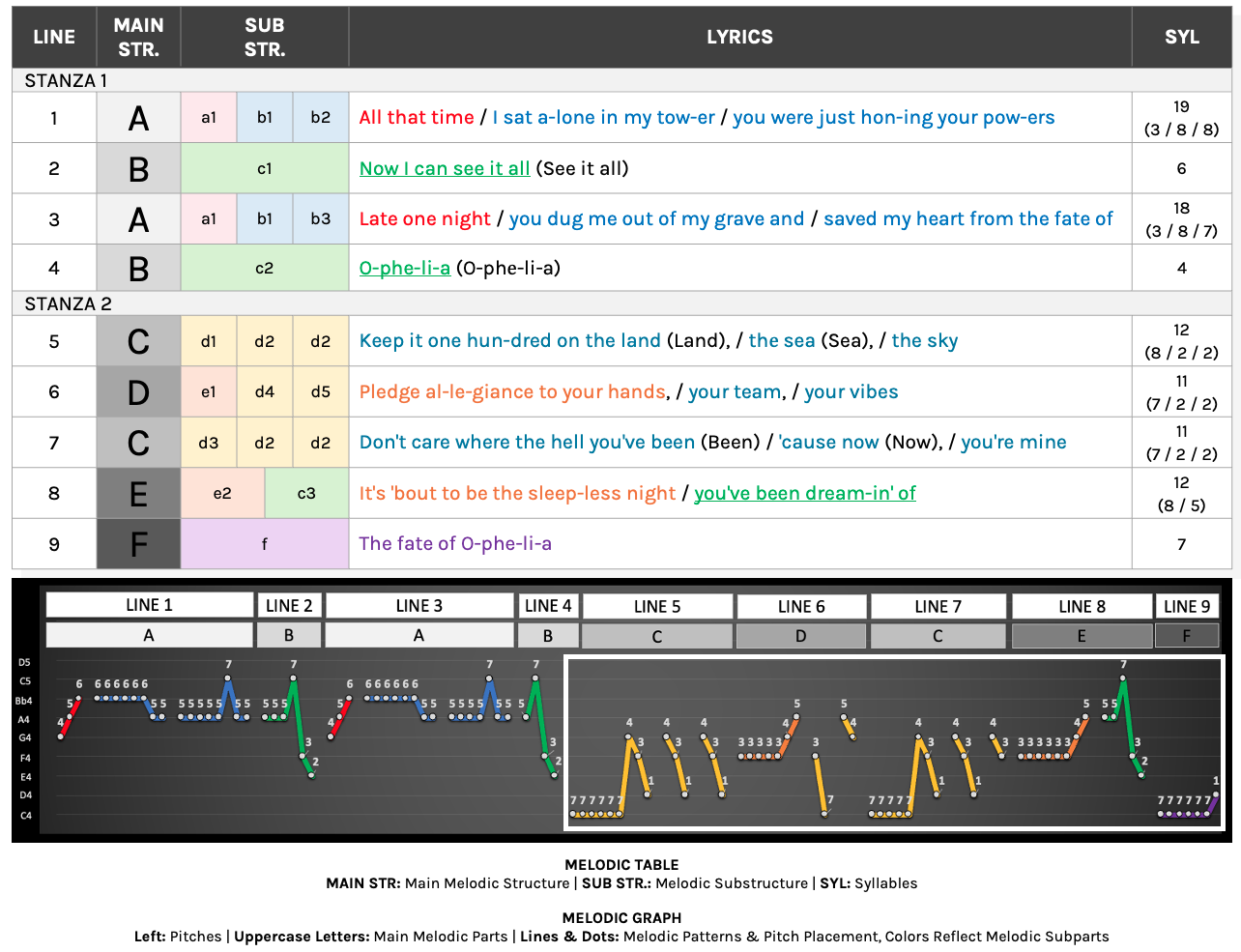
Lines 5 & 7
Line 5 is comprised of 12 syllables broken into three similar subparts (d1-d2-d2) consisting of an 8-2-2 syllable structure. Note this long-short-short flow is essentially the opposite of stanza 1’s 3-8-8 syllabic structure in its first line.
- Subpart d1 (8 syllables): Stanza 2’s opening melodic segment initially heightens engagement by starting an octave lower than stanza 1’s peak pitch on scale degree 7. However, it maintains cohesion with stanza 1 with a succession of fast-paced stagnant notes on the lyrics “keep it one-hundred on” that leads into an engaging 4-(3-1) slurred leap on the lyrics “the (la-nd).”
- Subparts d2-d2 (2 syllables each): The following melodic segments repeat the 4-(3-1) slurred pattern on the lyrics “the sea” and “the sky.”
Together, the leaping and descending d1-d2-d2 melodic patterns form what Hit Songs Deconstructed calls an A.M.P. (Alternating Melodic Pattern) nano hook – a melodic pattern that is highly prevalent in Max Martin’s Hot 100 hits. The pattern is then repeated in line 7 with subtle variation at the beginning. Further bolstering catchiness and connectivity between these two lines are the following:
- Internal and end-of-line rhyme connections: “land”/”hand,” “sea”/”team,” “sky”/”vibes”
- Background vocals: Swift’s lead delivery of “land,” “sea,” “been,” and “now” are directly followed by lower-level background vocal callbacks, further enhancing catchiness, rhythmic flow, and lyrical memorability.
Line 6
In between the line 5 and line 7 A.M.P.s is another three-part melody that heightens interest while still maintaining familiarity with the melodies that surround it:
- Subpart e1 (7 syllables): This melodic subpart builds on the preceding line by starting with a succession of notes on scale degree 3 (as opposed to scale degree 7) followed by a climb across scale degrees 4-5 (as opposed to a 4-(3-1) descent). However, the initial static motion and rhythm maintains familiarity with subpart d1 at the beginning of the lines that precede and follow.
- Subparts d4-d5 (2 syllables each): These short melodic fragments are essentially engaging variations of the d2 melodies in lines 5 and 7.
Together, the melodies across lines 5, 6, and 7 create a highly catchy flow that is both engaging and memorable. However, one distinction to note with line 6 is that it omits the background vocal callbacks. This was a strategic choice that helps to prevent redundancy.
Line 8
The second-to-last line in the chorus essentially fuses together two existing melodies in a fresh new context:
- Subpart e2 (“It’s ‘bout to be the sleep-less night”): A near reprise of the e1 melody initially featured at the beginning of line 6 (“pledge al-le-giance to your hands”).
- Subpart c3 (“you’ve been dream-in’ of”): A near reprise of the of the c1 and c2 E.O.L.A. song title hook melodies featured in lines 2 and 4 of stanza 1, along with shared near rhymes.
Line 9
The chorus concludes with a fresh yet familiar iteration of the song title hook – “the fate of O-phe-li-a.” Instead of reprising the familiar E.O.L.A. patterns that defined the song title hook melody in subparts c1, c2, and c3, here it begins with a succession of notes on scale degree 7 - a commonality shared with the beginning of lines 5 and 7 but with a different rhythm. It then concludes with a step up to the root note (scale degree 1), which ends the chorus in a resolved manner. Further differentiating this melody is the more subdued manner that Swift delivers it, providing the hook with new emotional context.
Conclusion
The chorus of “The Fate of Ophelia” is a masterclass in how melodic simplicity, paired with deliberate structure and contrast, yields exceptional impact. Rooted in the Max Martin-style melodic math approach, every phrase is crafted to feel both intuitive and fresh. It is familiar enough to connect instantly, yet varied enough to maintain engagement across repeated listens.
The integration of A.M.P., E.O.L.A., and background vocal call-and-response hooks ensures that multiple melodic and rhythmic entry points reinforce one another, maximizing memorability, emotional pull, and catchiness.
Ultimately, the chorus achieves a balance that few songs manage to strike: it’s mathematically structured for maximum recall yet emotionally delivered for lasting resonance. It’s this seamless blend of logic and feeling that makes “The Fate of Ophelia” a standout example of pop melodic craft at its finest.
Subscribers can access the full technique analysis by clicking here.
Join the Hit Songs Deconstructed Community
Save 15% with code "CREATE".
Sign up to receive our free newsletter, the HSD Wire!
What Industry Executives Are Saying About Hit Songs Deconstructed
"ASCAP aims to provide members with a multifaceted toolchest to augment their craft and their careers. Hit Songs Deconstructed is a cutting-edge service that can support our members' creative process with in-depth data and analysis of current songwriting techniques."
Nick Lehman
Chief Strategy & Digital Officer, ASCAP
"I find the site VERY valuable. I’m a fan."
Eric Hurt
VP, A&R Publishing / Nashville at EMPIRE
"Hit Songs Deconstructed reveals so much detail about things you might never have noticed before in hit songs, but are right in front of you. They go beyond identifying what works and explain WHY it works."
Jem Aswad
Executive Editor, Music at Variety
What Songwriters & Producers Are Saying About Hit Songs Deconstructed
"I can't stress enough how important HSD is to any serious professional hit songwriter."
Hilton Wright II
Record Producer/Songwriter, Billboard #1 RIAA Platinum & Gold winning songwriter & producer, (Drake, Mike Posner, black•𝘪𝘴𝘩)
"As a songwriter, an important part of my job is to analyze what works in successful songs. By identifying the tools that were employed in hits, writers can incorporate them into their own songs--using techniques that have proven successful--while putting their own spin and unique creative angle on them. HSD does the research for me."
Jason Blume
Songwriter w/50 million album sales
"Even though I’ve been writing professionally for over ten years, I’ve found several nuggets of gold that have improved my writing already."
Roy Stride
Hit Songwriter, Producer, Artist, One Direction, 5 Seconds of Summer, Scouting for Girls
"Spot on with the analysis and relevant to any composer, songwriter, or producer in the game now.”
Dr. O
Producer, Young M.A., Chris Brown, Lil Wayne
"I was blown away by the Max Martin Hits masterclass. So thorough and insightful - a great blend of theory and art."
Amy Sky
Recording Artist, Songwriter, Producer, 3x SOCAN-winning singer-songwriter
"I’m going on 40 years of working with top-level artists and you have made me understand even better all the things I’ve learned over the years working with them.
Thanks much for all you do."
Khaliq Glover
Grammy Award Winning Recording Engineer (We Are the World, Justin Timberlake, Christina Aguilera),
What Leading Popular Music Programs Are Saying About Hit Songs Deconstructed
“I have been giving hit record analysis exercises to my students for years, but the level of depth in a single Hit Songs Deconstructed report is a full semester’s worth of information. My entire thought process as a producer, an engineer, a musician, and a songwriter are fleshed out in the pages of the HSD reports. It is such a great tool that I’m integrating it into the songwriting and music production curriculums.”
"Prince" Charles Alexander
Grammy Award winning producer, audio engineer, recording artist and professor, Music Production and Engineering, Berklee College of Music
"The depth, detail and level of care that Hit Songs Deconstructed exercises in their song analysis is something I want my students to aspire to. I am using their analysis techniques as a benchmark for them to apply when analyzing songs, their compositional analytics to keep them in tune with what’s happening now, and the quarterly trend reports to keep them up to speed with who the key industry players are. Additionally, it’s a huge time-saver when it comes to prepping for classes. I can pick any compositional variable in the database based on what I’m going to be discussing in a lecture and easily find examples of current hits."
Chris Sampson
Founding Director, Popular Music Program, USC Thornton School of Music
"Hit Songs Deconstructed is a great teaching tool and an extremely valuable resource for my songwriting students. We’ve made it an integral part of the songwriting curriculum at MTSU and I’m thrilled to say that Middle Tennessee State University is at the forefront of songwriting education as a result of this partnership."